A Celebration of Spirits
Speaker Spotlight: Tequila, Mezcal, and a Taste of Oaxaca
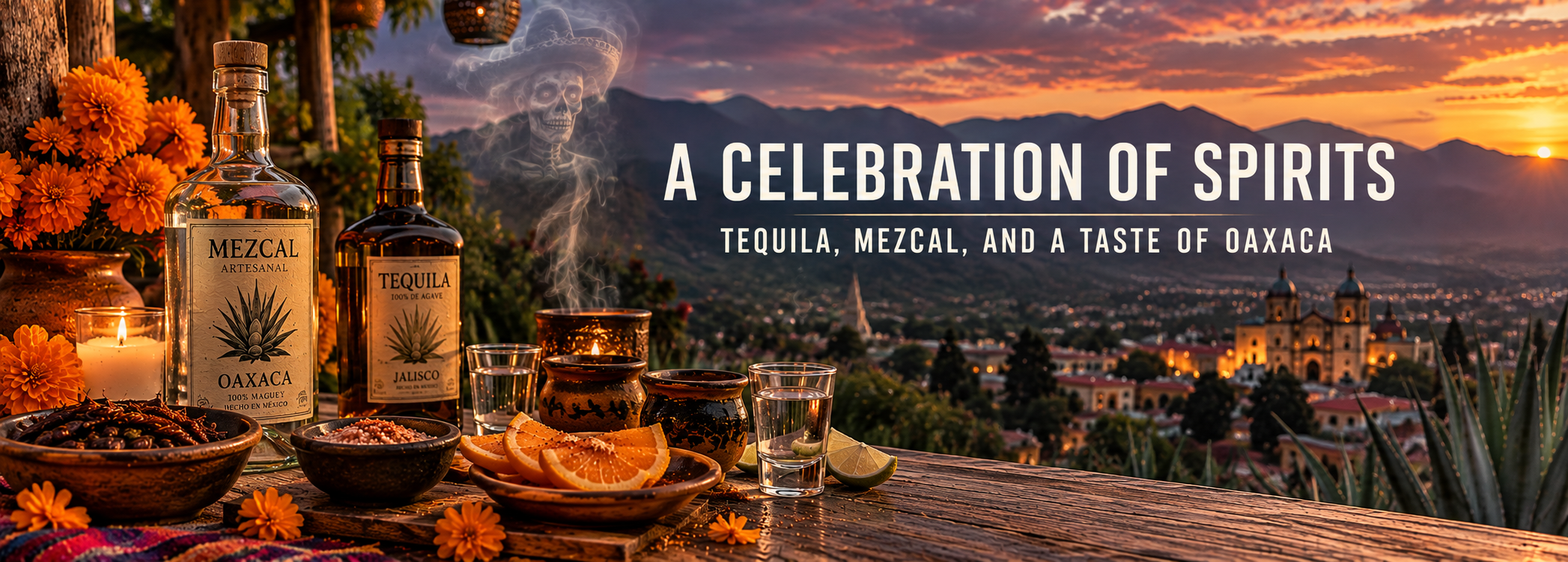
There will be an optional Agave Spirits class and tasting during Naughty Halloween. Bob, one of the original owners of Naughty Events, will lead the class. He currently lives in Oaxaca, Mexico—the heart of mezcal country—and will introduce tequila, mezcal and some of the traditions surrounding how they're made and enjoyed.
Giving Mezcal a chance
Maybe you've tried mezcal before. Somebody handed you a shot; you knocked it back the same way you've probably done tequila; it tasted like someone started a campfire in the back of your throat, and you immediately decided, “Nope. I don't like mezcal.”
I understand. But I'm going to ask you to give it another chance.
I live in Oaxaca, Mexico, which puts me right in the heart of mezcal country. Living here has changed how I think about mezcal because I've discovered how different one bottle can be from another. Some are smoky, but others are fruity, grassy, herbal, earthy, mineral, or even a little medicinal. Some are incredibly smooth, while others let you know immediately that you're drinking a serious spirit. Saying you don't like mezcal because you tried one you hated is a little like somebody handing you a glass of really sweet, cheap Moscato and deciding from that experience that you don't like wine. Maybe you don't—or maybe you didn't like that wine.
Since we're celebrating Día de Muertos (Day of the Dead), this seems like a particularly appropriate time to talk about Mexican spirits. Mezcal is deeply connected to Oaxaca, and you'll even find it placed on an ofrenda (altar offering) to welcome back loved ones who have died for a visit. We'll talk much more about ofrendas elsewhere, but for now we're going to celebrate a different kind of spirit.
Let's Start With Champagne
Here's one of my favorite ways to explain tequila and mezcal, and I'm going to intentionally oversimplify before coming back with the facts.
Champagne must come from the designated Champagne region of France and meet the standards required to bear the name Champagne. Plenty of wonderful sparkling wines are made elsewhere, but they can't simply put “Champagne” on the bottle.
Everything else is sparkling wine.
Keep that idea in mind, because Mexico does something similar with tequila. Tequila has its own Denominación de Origen (Denomination of Origin) and rules governing where and how it can be produced. It must be made using one specific variety of Agave: Agave tequilana Weber variedad azul, better known as Blue Weber agave.
Most of us associate tequila with Jalisco, and for good reason, but the legal tequila territory is actually larger. It includes all of Jalisco and designated municipalities in Guanajuato, Michoacán, Nayarit, and Tamaulipas. The Consejo Regulador del Tequila, or CRT (Tequila Regulatory Council), is responsible for verifying that tequila complies with the applicable standards and requirements.
One more tequila distinction is worth knowing. A bottle labeled "Tequila 100% de Agave" must derive all of its fermentable sugars from Blue Weber agave. Regular tequila must still use Blue Weber agave, but up to 49% of its fermentable sugars may come from other permitted sugars. That's the tequila sometimes referred to as mixto, although you normally won't see the word mixto printed on the bottle.
So Champagne comes from its designated territory and follows Champagne's rules. Tequila uses Blue Weber agave, comes from its designated territory, and follows tequila's rules.
Everything else is mezcal.
Well...not really.
But now I've got your attention.
So What Is Mezcal?
Calling every other Mexican agave spirit mezcal would make this much easier, but it wouldn't be true. Mezcal has its own protected Denominación de Origen, like tequila. Mexico also has other traditional spirits with their own identities, including Raicilla and Bacanora, and you may encounter bottles labeled destilado de Agave (agave distillate) that legally cannot be sold as mezcal.
The important point isn't memorizing all those categories. It's important to understand that tequila represents a very specific corner of a much larger Mexican tradition of distilling Agave. Mezcal opens that door much wider, particularly when we start talking about the different kinds of maguey (Agave) used to make it.
And this is where mezcal gets really interesting.
Tequila Gets One Agave. Mezcal Gets a Whole Family.
Tequila gets Blue Weber. That's it.
Mezcal can be made from many different species and varieties of Agave, and those plants don't all taste alike when they're turned into mezcal. Where they grow, how long they mature, the soil and climate, how they're cooked and fermented, and how the maestro mezcalero (mezcal maker) handles distillation can all affect what ultimately ends up in your glass.
Here in Oaxaca you'll hear names such as Espadín, the most commonly used Agave for mezcal and a great place to begin; Tobalá, famous for producing complex and often highly prized mezcals; Cuishe or Cuixe, Madrecuixe and Barril, all names commonly associated with the Agave karwinskii family; Tepeztate or Tepextate, generally Agave marmorata; Arroqueño, commonly associated with Agave americana; Mexicano, often Agave rhodacantha; and Jabalí, generally Agave convallis and notoriously difficult for mezcaleros to work with.
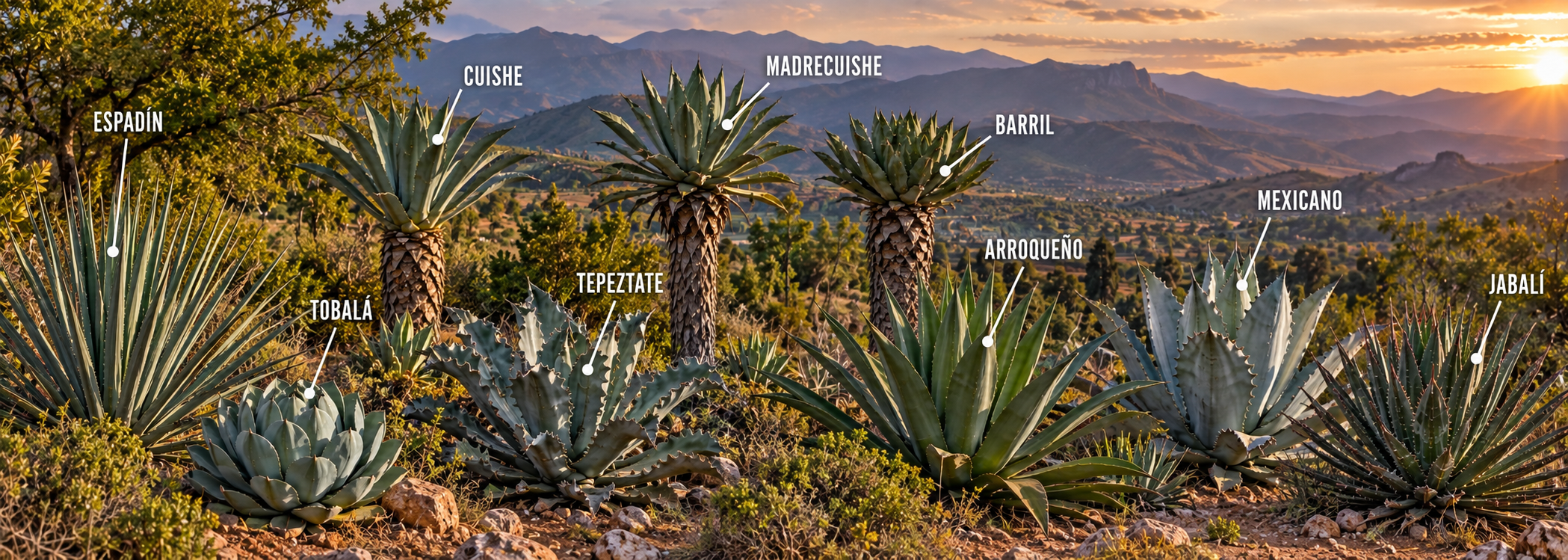
That's only a sample. It also gets wonderfully complicated because the common names aren't perfectly standardized throughout Mexico. A name used for a particular maguey in one community may be used somewhat differently somewhere else. This is agriculture, tradition, and generations of local knowledge, not simply a liquor company following a recipe in a factory.
Once you understand that, one of the biggest misconceptions about mezcal starts falling apart.
“Isn't Mezcal Just Smoky Tequila?”
No, and this may be the single biggest takeaway from this article.
Smoke certainly can be an important flavor in mezcal. Traditional mezcal is often made by cooking the hearts of the agave—the piñas—in an horno de tierra (earthen pit oven) using heated stones. That cooking process can contribute smoky characteristics, but smoke is only one possible part of the finished spirit.
I've tasted very smoky mezcals and others where smoke was barely noticeable. Some tasted grassy or herbal to me. I've found others fruity, earthy, mineral, or medicinal. Some have a pronounced alcohol character, while others are surprisingly soft and easy to sip. Those are tasting impressions rather than rigid categories, but that's precisely the point: there isn't one flavor called “mezcal.”
Asking “What does mezcal taste like?” is a little like asking what wine tastes like. A Cabernet doesn't taste like a Moscato simply because they're both wine, and two Cabernets grown in different places and made by different winemakers don't necessarily taste the same either. Mezcal has that same kind of diversity, which is why I don't think one bad experience is enough to decide that the entire category isn't for you.
Budweiser, Craft Beer and Some Very Traditional Monks
Now that we've talked about different agaves, there's another important distinction to understand. Mexican regulations recognize three production categories: Mezcal, Mezcal Artesanal (Artisanal Mezcal), and Mezcal Ancestral (Ancestral Mezcal).
I'm going to oversimplify again, because I think beer gives us an easy way to remember them.
Think of regular Mezcal as the big commercial brewery: Budweiser, Miller Lite, or Coors Light. Modern equipment makes larger-scale, more standardized production possible. Mezcal Artesanal is more like the craft-beer world, where traditional processes and more hands-on production are central to the making. Then imagine Mezcal Ancestral as monks making beer at a monastery, using traditional methods passed down for generations.
Before a mezcal expert throws something at me, those are analogies, not the legal definitions. A small producer isn't automatically Artesanal, and a large producer isn't automatically in the regular Mezcal category. The official distinction depends mainly on which production methods and equipment are permitted.
With Mezcal Artesanal, traditional methods can include cooking the agave in earthen pit ovens, crushing the cooked agave with a tahona (large stone milling wheel), fermenting in vessels made from materials such as wood, stone, or clay, and distilling with traditional equipment such as copper stills or clay pots. Mezcal Ancestral is even more restrictive: the agave must be cooked in a pit oven, traditional crushing methods are required, fermentation includes the agave fibers, and distillation takes place over a direct fire in clay pots.
That last category particularly fascinates me because you're tasting a spirit made using remarkably traditional techniques. I sometimes find Ancestral mezcals especially earthy or mineral-driven, but I wouldn't say that clay automatically makes every Ancestral mezcal taste earthy. Too many other variables are involved. As you've probably figured out by now, mezcal doesn't particularly like being put into simple flavor boxes.
If You Hated Mezcal Because You Shot It, We Need to Talk
One of the easiest ways to have a terrible first experience with mezcal is to take a good, relatively high-proof mezcal and throw the entire thing into the back of your throat like you're doing a shot at a college bar.
In Oaxaca, you'll commonly see mezcal served in a small copita (tasting cup), sometimes made of clay. The idea is to sip it. Start with a very small amount and let your mouth adjust to the alcohol. Smell it, take another small sip, and see what starts appearing. You may begin noticing flavors that were completely overwhelmed by alcohol on that first taste.
There's a saying associated with drinking mezcal: “El mezcal se besa” — mezcal is kissed. That's a much better image for how to approach it. You're not trying to get the mezcal down as quickly as possible; you're giving yourself enough time to figure out what's actually in the glass.
And despite its reputation, mezcal isn't automatically some extraordinarily strong liquor compared with everything else behind the bar. Certified mezcal can legally range from 35% to 55% alcohol by volume, so some traditional expressions certainly are stronger than a standard 40% spirit. That's another reason to pay attention to the bottle and sip rather than shoot.
Orange, Worm Salt, and a Grasshopper
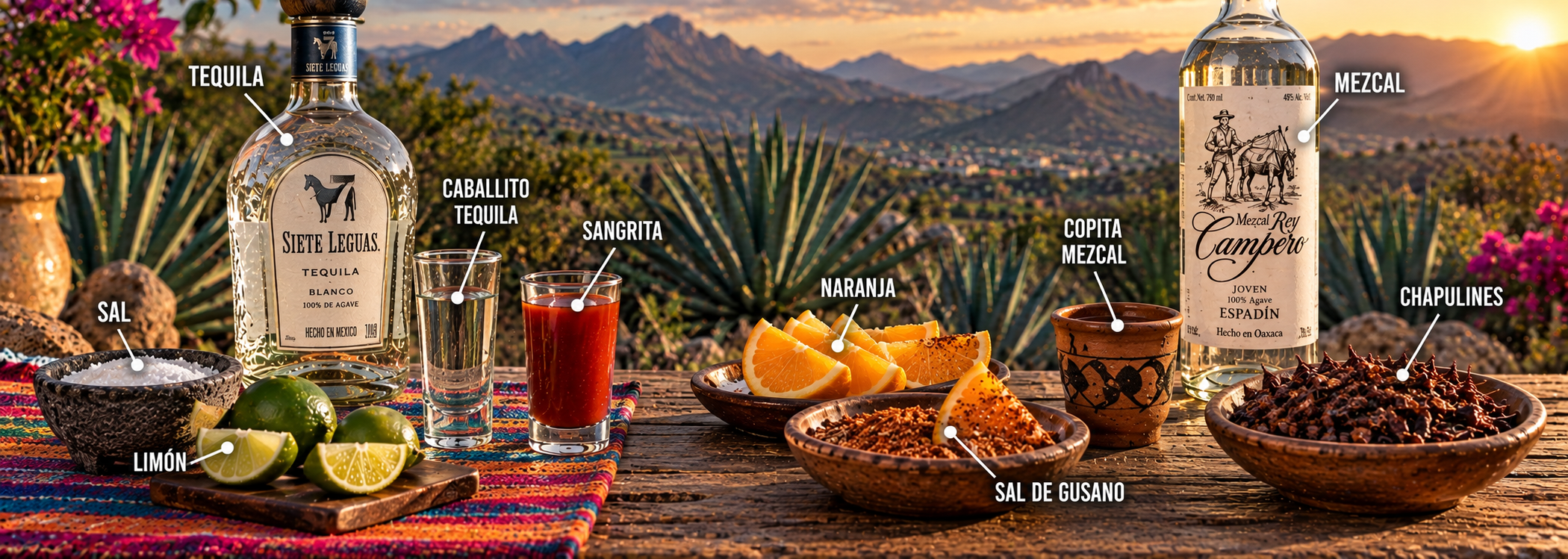
If you're accustomed to the American tequila ritual of salt, shot, and lime, the Oaxaca mezcal experience may look a little different. One accompaniment you'll frequently encounter here is naranja (orange) served with sal de gusano (agave-worm salt).
And yes, there really is a worm in the worm salt. Sal de gusano is traditionally made with dried, ground agave larvae, salt, and chile, though recipes vary by producer. Put a little on a slice of orange. Taste the mezcal by itself first, then try the orange with the sal de gusano, and go back to your mezcal. The combination of sweetness, citrus, salt, and chile can change what you're noticing in the spirit.
The orange and sal de gusano aren't there because good mezcal needs something to mask its flavor. Think of them as accompaniments that let you experience the spirit differently. And while we're talking about Oaxaca, there's another traditional food that pairs beautifully with mezcal: chapulines (grasshoppers).
Chapulines are commonly toasted and seasoned with chile, salt, lime, and garlic. They're crunchy, salty, and surprisingly good with mezcal. I realize some of you may have just decided that the worm salt suddenly sounds like the conservative option, but you've come this far. Eat the damn grasshopper.
Tequila Deserves Better Than the Shot Glass Too
Tequila has suffered from similar treatment. For a lot of Americans, tequila means licking salt off your hand, throwing back a shot, and biting into a lime as quickly as possible. Some Mexicans drink tequila with salt and lime too, but that ritual isn't the only way—or necessarily the best way—to appreciate a good tequila.
One traditional accompaniment worth trying is sangrita, served in a separate small glass alongside tequila. You alternate between sipping tequila and sangrita rather than mixing them. Despite the similar names, sangrita has nothing to do with sangria; the name roughly translates as “little blood,” referring to its red color.
No single universal sangrita recipe exists. Traditional and modern versions can include combinations of orange and lime juice, chile, salt, and pomegranate or grenadine, while tomato juice is also very common in contemporary versions. The fun is in going back and forth between tequila and sangrita, noticing how the sweet, sour, salty, and spicy flavors affect your perception of tequila.
If your tequila experience has mostly involved trying to get the shot down quickly enough that you don't taste it, this is a much more civilized introduction.
Mezcal Also Belongs in a Cocktail
After spending all this time telling you to slow down and taste mezcal neat, I'm going to tell you to put some in a cocktail.
Mezcal makes fantastic cocktails because its character doesn't disappear when you add other ingredients. One of my favorites combines mezcal with jamaica (hibiscus). If you've spent much time in Mexico, you've probably encountered agua de jamaica, the beautiful deep-red hibiscus drink that's served everywhere. Its tart, fruity character works particularly well with mezcal.
For a Mezcal Jamaica, I like 2 ounces of Espadín mezcal, 1½ ounces of strong chilled agua de jamaica, ¾ ounce of fresh lime juice, and about ½ ounce of agave syrup. A small amount of orange liqueur is optional, and a partial rim of sal de gusano or Tajín works nicely. Shake everything with ice, then serve over fresh ice.
I specifically use Espadín here because it's widely available, generally approachable, and works beautifully in cocktails. If someone has just poured me an expensive, small-production Tobalá or Tepeztate with subtle characteristics, I'm probably not covering those up with hibiscus, lime, and sweetener. I'm going to sit there and enjoy that one slowly.
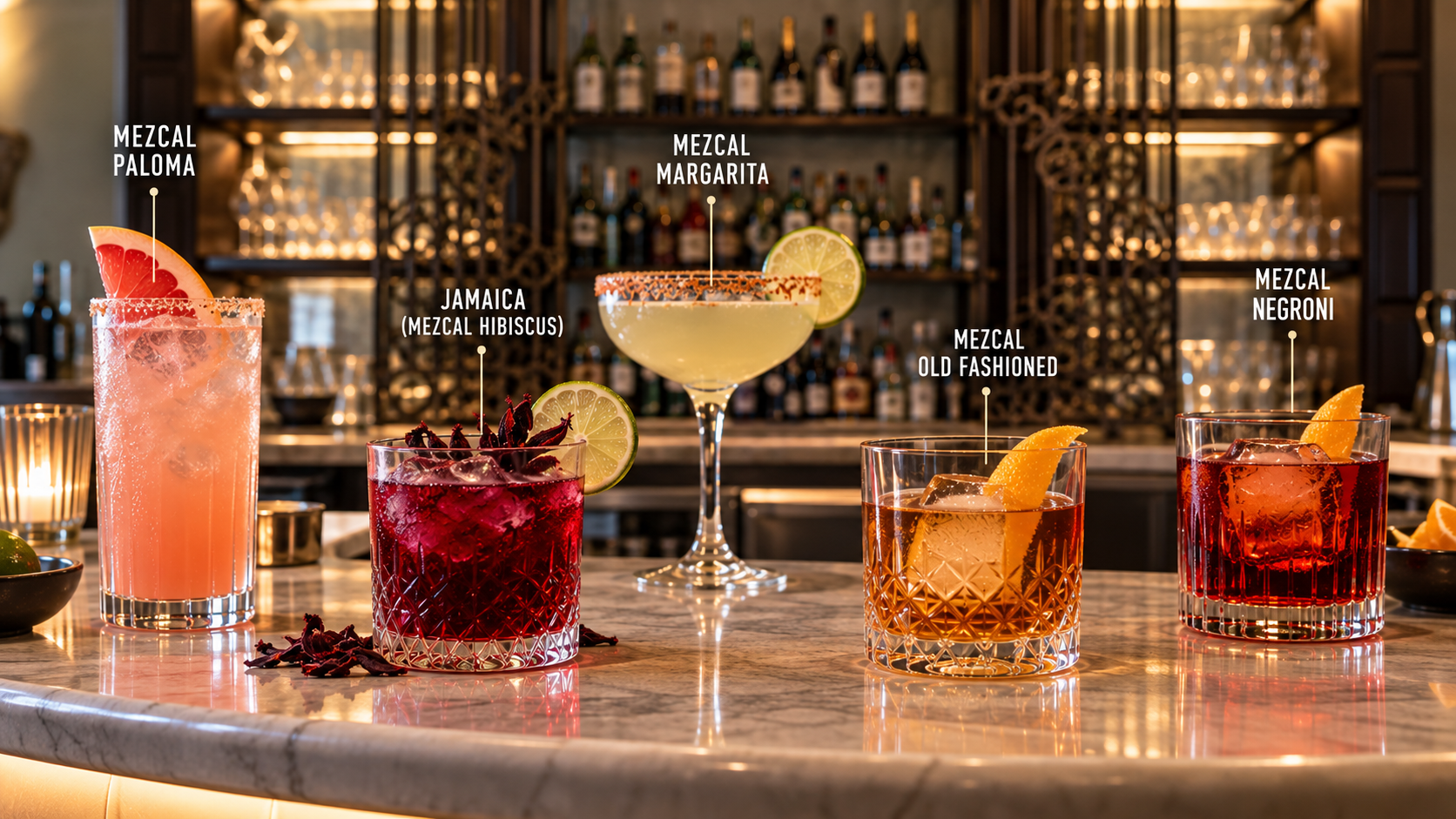
Another favorite is a Mezcal Old Fashioned. Mezcal, a little agave syrup, bitters, and orange peel can make a fantastic drink, or you can split the base between mezcal and reposado tequila. That's a particularly good bridge for someone who enjoys an Old Fashioned but isn't yet convinced they want to sit around sipping mezcal neat.
You Don't Have to Like Scotch to Like Mezcal
People often tell me that Scotch drinkers are natural mezcal drinkers because they're already accustomed to smoke. There's some truth to that, particularly for someone who enjoys heavily smoky Scotch, but I don't think you need to like Scotch at all.
I'm not a huge Scotch drinker, and I love mezcal.
That's because what I enjoy about mezcal isn't just the smoke. It's the variety. You might love something grassy and hate something medicinal. You may discover that you like Espadín in a cocktail but prefer sipping Tobalá neat. You may love one Ancestral mezcal and dislike the next one. The more you taste, the harder it becomes to describe mezcal as a single flavor.
And if you taste several different mezcals, try them properly, experiment with the orange and sal de gusano, and still decide you don't like mezcal, that's perfectly fine. Nobody needs to convince you to like something you don't enjoy.
But at least now you've actually given mezcal a chance.
A Celebration of Spirits
You don't need to walk away from this remembering the Latin names of agaves or every Mexican state covered by a Denomination of Origin. Nobody is giving you a test.
Remember that tequila uses Blue Weber agave and follows specific geographic and production rules. Remember that mezcal can be made from many different agaves, and that the plant, where it grows, and how the spirit is produced can result in remarkably different flavors. Remember that Mezcal, Mezcal Artesanal, and Mezcal Ancestral are actual regulated production categories, even if Budweiser, craft beer, and monastery-brewing monks are considerably easier to remember than Mexican regulations.
Most of all, remember that mezcal isn't just smoky tequila.
So if your entire relationship with mezcal consists of somebody handing you a shot once, throwing it down your throat and thinking it tasted like a burning tire, I'm asking you to start over. Take a small sip. Give it a moment. Take another. Try the orange and sal de gusano. Try a different agave. Try one in a cocktail.
And while you're here in Oaxaca, eat the damn grasshopper.
You may discover that you never really hated mezcal. You just hadn't met the right one yet.
If this article interests you and you will be at Naughty Halloween, sign up for the class/tasting here.