The Naked Truth About Producing Lifestyle Hotel Takeovers
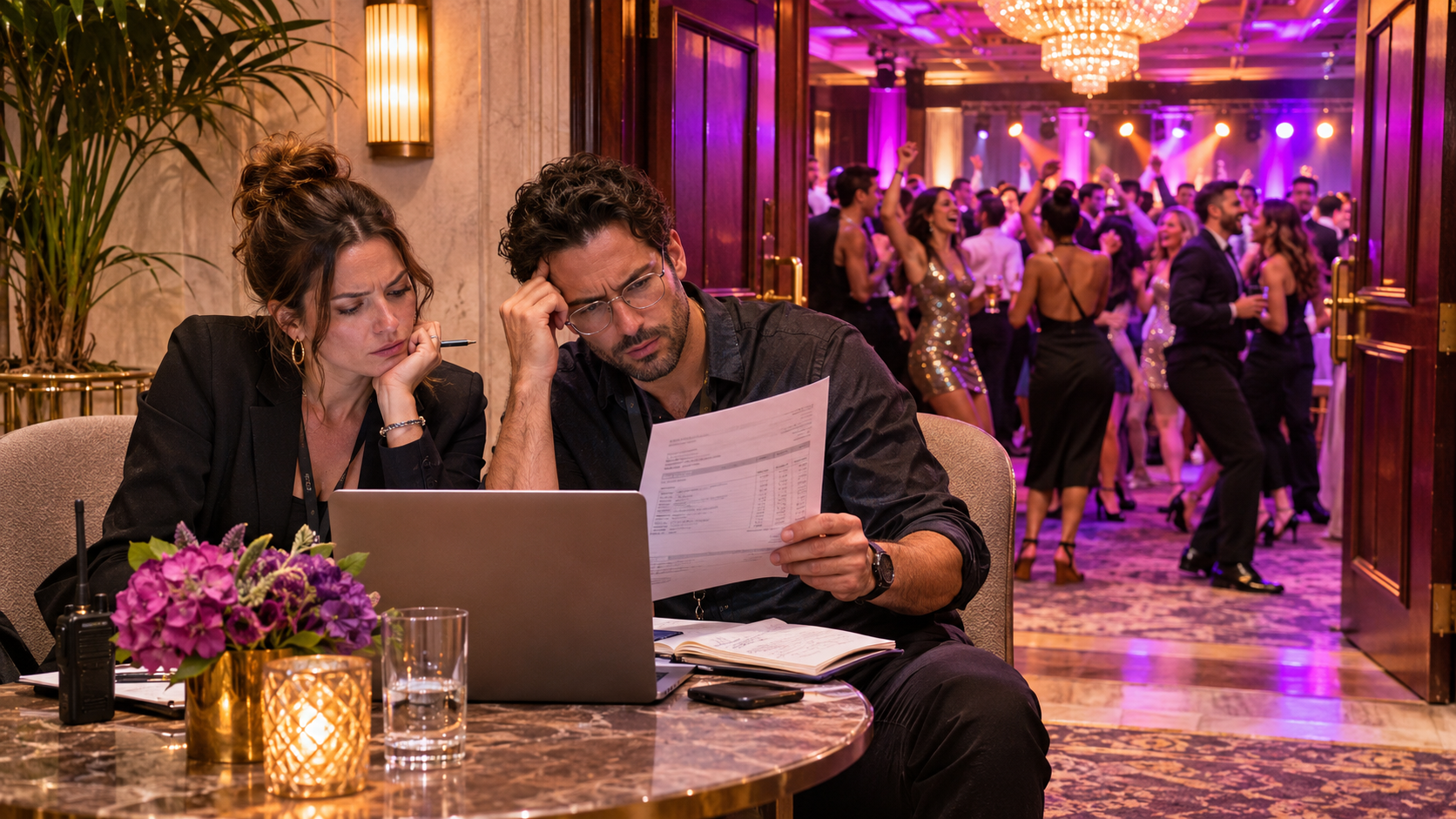
We've been producing lifestyle events for a long time, and one thing we've learned is that putting on a successful hotel takeover is a whole lot harder than it looks.
From the outside, it seems like a pretty great business. Find a hotel, sell some tickets, bring together a few hundred open-minded adults, throw an incredible party, and hopefully make some money along the way.
What could possibly go wrong?
Quite a lot, actually.
Over the years, I've watched people attend successful lifestyle events and decide they wanted to produce one themselves. I understand the attraction. There's something incredibly rewarding about bringing people together, watching friendships develop, and creating experiences people will remember for years.
But there's another side to this business that most attendees never see.
It's the financial risk, the contracts, the sleepless nights, the personal sacrifices, and the responsibility that comes with accepting people's money and promising them an experience.
I've learned some of these lessons the hard way, and I think they're worth sharing.
Everybody Wants to Get Into Bed With a Hotel… Until the Bill Comes Due
Let me tell you about our very first hotel takeover.
We booked a hotel with 302 rooms. We sold 176.
Now, stop and think about that for a moment. Selling 176 hotel rooms for a first-time lifestyle event is an incredible accomplishment. By almost any reasonable measure, that's a successful turnout.
We had a great event. People had a wonderful time. From the attendees' perspective, everything looked like a success.
But we had booked a 302-room hotel. That meant 126 rooms went unsold and that is 126 rooms times 3 nights times $110.
Ouch!
And that did not include all the food we ordered, bands we paid, DJs, lighting, decor, rooms we rented for staff and playrooms, payments to security and entertainers, and so on…
And when the party was over and the bills came due, I had to take out a $40,000 loan to settle our financial obligations with the hotel.
Forty thousand dollars. That's a pretty expensive education in hotel event production.
Here's the lesson: A successful event and a profitable event are not necessarily the same thing.
Our dance floor was packed, our attendees were thrilled, and everyone was talking about how wonderful the weekend was. Meanwhile, we were sitting in our room trying to figure out how to pay the hotel.
Most attendees never see that side of the business, and frankly, they shouldn't have to. They paid for an experience, and our responsibility was to deliver it. But anyone thinking about becoming an event producer needs to understand that the financial risk is very real.
The Hardest Part of a Hotel Takeover Isn't Getting It Up… It's Keeping It Going
One of the biggest mistakes I see new promoters make is starting too big. They attend a successful event with hundreds of people, see a packed hotel, and think they can do the same thing.
Then they start looking at hotels with 150, 200, or even 300 rooms. My advice to anyone producing their first hotel takeover is simple:
Start with 70 rooms or fewer.
If you sell out, congratulations! You've created demand. You can arrange overflow rooms at a nearby property, and people will be excited to book earlier for your next event.
But if you start with a 200-room hotel and sell only 120 rooms, you may have a serious financial problem.
I've seen promoters spend the final weeks before an event desperately trying to sell the last 15 or 20 percent of their rooms, not because they want more attendees, but because they need those sales to meet their financial obligations.
That's a terrible position to be in.
And historically, even filling 150 rooms is a pretty high bar for a lifestyle takeover, especially for a new promoter without an established customer base.
A smaller hotel that sells out can create a fantastic atmosphere. People are together, the energy is concentrated, and the event feels successful. More importantly, the financial exposure can be substantially lower.
There's no shame in hosting a successful event at a 50-room hotel. There's plenty of risk in booking a 300-room hotel because you're convinced hundreds of people will show up.
Growth should follow demonstrated demand, not wishful thinking, and just because you can sell tickets doesn't mean you can afford to produce the event.
Behind Every Great Orgy Is Someone Sweating Over a Spreadsheet
Here's something that surprises many aspiring event producers.
Hotels aren't in the lifestyle business. They're in the hotel business.
Their responsibility is to generate revenue for their owners, and their decisions are generally based on historical occupancy, room rates, food-and-beverage revenue, operating costs, and financial projections.
When an ordinary convention books a hotel, the property may allow substantial attrition in the room block. Depending on the agreement, the group might only have to fill 50 or 60 percent of its committed rooms, or it may have scheduled deadlines to release unused inventory.
Why?
Because the hotel can often sell those unused rooms to other guests. A lifestyle hotel takeover is different. In many cases, we're asking the hotel to give us exclusive use of the property. We don't want unrelated guests checking in for a family vacation while our attendees are enjoying a lifestyle weekend.
That means the hotel cannot simply resell our unused rooms to the general public, and that changes the financial equation dramatically.
If a hotel's historical occupancy for a particular weekend is 80 percent, its revenue department knows what the property would ordinarily expect to earn. They're not necessarily going to accept a contract that puts that revenue at risk without compensation.
They may require us to guarantee 80 percent occupancy, 90 percent, 95 percent, or potentially the entire room inventory. The actual requirements vary considerably by hotel, dates, rates, and contract. But the underlying principle is the same.
If the hotel cannot resell the rooms, someone has to assume the financial risk of those rooms sitting empty.
And that someone is often the event producer.
Sometimes you can negotiate more flexibility by agreeing to higher room rates. For example, a hotel might be willing to accept a lower room commitment if guests are paying $120 per night instead of $100.
That's not the hotel trying to take advantage of anyone. It's a revenue calculation. The same principle applies to food and beverage.
I've heard promoters complain because a hotel won't let their guests bring their own alcohol, or because the property requires a food-and-beverage minimum. But those are ordinary considerations in hotel contracts.
Hotels earn substantial revenue from bars, restaurants, and catering. They also have liquor licenses, insurance requirements, and operating policies they must follow.
Some hotels cannot legally or contractually permit the kind of outside alcohol service a promoter wants. Others may allow limited exceptions under specific conditions.
And yes, hotels may prohibit hanging decorations on walls, modifying rooms, or doing things that could damage the property. Those aren't necessarily unreasonable demands; they're normal business considerations.
I've watched promoters become frustrated because a hotel wouldn't agree to everything they wanted, without recognizing that the hotel has financial obligations of its own. The hotel answers to its management company. The management company answers to the owners. And everyone is expected to protect the property's revenue.
A good promoter needs to understand that relationship.
You don't have to like every provision in a hotel contract. You can negotiate, compromise, or decide the property isn't a good fit, but you should understand what you're agreeing to before you sign.
And once you sign, those obligations become very real.
When the Party Stops, the Bills Don't
If there's one thing that can turn an event producer's world upside down, it's a cancellation. We experienced that firsthand during COVID.
Like countless other businesses, we suddenly found ourselves dealing with circumstances completely outside our control. The world was shutting down. Travel was disrupted. Events couldn't proceed, and we had customers who had already paid us.
We had to cancel our event, communicate with attendees, and figure out how to handle refunds during a period when nobody knew when the world would return to normal.
Fortunately, we had built enough trust with our customers that many agreed to transfer their payments to a future event, and that support made an enormous difference.
We were able to refund everyone who wanted their money back, while others voluntarily allowed us to hold their payments until events resumed. But even during a worldwide pandemic, we had angry customers. Some were furious, and we understood why.
People had planned vacations, taken time off work, arranged travel, and spent money on an experience that would no longer happen. The fact that the cancellation was outside our control didn't eliminate their disappointment. That experience taught me something important.
When people trust you with their money, your responsibility doesn't disappear just because circumstances change.
But I also learned how valuable compassion can be.
The customers who were willing to wait, transfer their payments, or simply give us a little breathing room helped us get through an extraordinarily difficult time. They didn't have to do that, and we've never forgotten it.
Not every cancellation is due to a pandemic. Sometimes ticket sales fall short. Sometimes hotel negotiations break down. Sometimes a promoter makes a serious mistake or takes on more financial responsibility than they can handle.
Those situations aren't all equivalent, and accountability matters, but the people behind these events are still human beings.
Many aren't wealthy business owners with enormous cash reserves. They're people with regular jobs, families, mortgages, and bills, who started producing events because they love the lifestyle and the community.
They invest their time, energy, and often their own money into creating something special, and when it falls apart, the financial and emotional consequences can be devastating.
That doesn't excuse poor decisions or eliminate the obligation to refund customers; it simply means we can hold people accountable without forgetting that they're human.
Keeping Your Money Safe Isn't the Sexiest Part of the Party
There's another financial risk in this industry that many new promoters don't even know exists: Credit card processing.
In 2018, we lost a merchant-processing relationship we'd maintained for almost 20 years, and that was a major disruption for our business.
Many new promoters assume they can simply open an account with a popular payment processor, start collecting credit card payments, and everything will be fine. Unfortunately, adult-oriented businesses and lifestyle events can fall under restricted or higher-risk merchant categories.
Companies such as PayPal and Square have policies governing certain adult-related transactions, and I've personally seen event promoters have funds frozen or processing interrupted because their business activity raised concerns with their processor.
Imagine having thousands of dollars in ticket revenue, a major hotel payment coming due, and suddenly discovering that you cannot access your money. That's not a hypothetical risk; it's something promoters need to understand before they start collecting payments.
When we lost our processor, we moved our ticketing to Modern Lifestyle.
One of the things that attracted us was their experience working specifically within the lifestyle industry.
From our experience, they have established relationships with multiple banking and merchant-processing partners that understand the kinds of events their clients produce. Rather than relying entirely on a single processing relationship, they have developed a structure to manage that risk.
That doesn't guarantee a processor will never hold funds or terminate a relationship. But having industry-appropriate processing arrangements is an important consideration.
There are several other reasons we've continued using them.
First, they provide an established professional ticketing system used for hundreds of lifestyle parties each year, including events at full-time lifestyle clubs.
Many attendees in our community are already familiar with the platform. That familiarity can add credibility when someone is considering buying tickets from an event producer.
Second, they use structured payout schedules and retain a portion of ticket revenue based on their assessment of an event's financial risk.
That means promoters don't necessarily receive every dollar the moment a customer purchases a ticket.
Some funds are held back and released closer to the event or afterward, helping maintain financial safeguards and potential refund capacity.
I consider that a good thing.
There's nothing inherently wrong with using advance ticket revenue to pay legitimate event expenses. Marketing, staffing, entertainment, deposits, and other costs have to be paid before the event happens.
But spending every dollar as soon as it comes in leaves very little room for something to go wrong.
Third, Modern Lifestyle provides tools for managing chargebacks and allows other promoters to sell tickets through a commission-based arrangement, with the platform handling the associated payouts.
They also offer membership options that can provide promoters with recurring revenue outside of major event ticket sales.
That kind of recurring income, when backed by genuine membership value, can help a small event business cover ongoing expenses without depending entirely on money collected for future events.
None of these tools guarantees that an event will succeed.
They won't fix an unrealistic hotel contract, poor attendance, or an event that was never properly secured, but they can provide financial and operational advantages that are easy to underestimate until something goes wrong.
Could a professional ticketing and financial-management system have helped some of the promoters who've recently experienced cancellations?
I believe it might have reduced certain risks and made the financial consequences easier to manage.
Would it have prevented their cancellations? Nobody can say.
And before anyone thinks I've suddenly become a spokesperson for Modern Lifestyle, let me be clear.
This isn't a commercial for Modern Lifestyle. It's a blog about producing events, and Modern Lifestyle is simply one of the tools we've used along the way to help make our events successful.
The lesson isn't that everyone needs to use the same company we do. It's that promoters need to understand the financial risks they're assuming and put appropriate systems in place to protect their business and their customers.
Trust Is the Ultimate Turn-On
Of all the things I've learned producing lifestyle events, this may be the most important: Customer confidence is worth its weight in gold.
You can have an incredible venue, outstanding entertainment, fantastic themes, and the best party plans imaginable, but if people don't trust you, none of it matters.
When someone buys a ticket to your event, they're doing more than purchasing admission, they're trusting you with their money, their vacation plans, their time, and often their personal privacy.
They're trusting that the hotel is secured, the event is properly planned, and the experience you've advertised is actually going to happen, and that's a tremendous responsibility.
And when something goes wrong, communication becomes almost as important as the solution itself: Customers deserve honest answers.
They deserve to know what's happening, what their options are, and when they can reasonably expect a refund.
They don't necessarily need to hear every detail of a promoter's personal financial problems or emotional struggles.
They need to know they're being treated respectfully and that their concerns are being taken seriously.
We've learned that over the years.
These days, I often use AI to help review difficult communications before I send them. It helps me organize my thoughts, remove unnecessary emotion, and consider how a message might be received by someone who sees the situation very differently than I do.
That doesn't mean allowing technology to speak for you. It means using another tool to communicate more clearly when emotions are running high, and when you're dealing with hundreds of disappointed customers, that can make a real difference.
I also believe attendees have an opportunity to show compassion when an event is canceled.
If a promoter has been honest, communicates regularly, and genuinely works to make things right, customers who are financially comfortable waiting may choose to give them additional time.
But that patience should always be voluntary.
Nobody should be made to feel guilty for requesting money they're owed.
And if someone genuinely needs an urgent refund, I hope promoters will consider those circumstances when prioritizing payments while treating everyone fairly.
There's also a path forward for promoters who decide that large hotel takeovers are no longer financially practical, and sometimes the best thing you can do is go back to basics.
Host a meet-and-greet. Rent a smaller venue for an evening. Charge a reasonable admission, bring people together, and create a wonderful experience without taking on enormous hotel obligations.
Make sure those smaller events can cover their own expenses without putting existing refund commitments at risk, and then do it again. And again.
Every event you successfully deliver is another opportunity to demonstrate that people can count on you, and you don't have to announce another enormous hotel takeover to prove you're still in business.
Sometimes rebuilding trust means doing something smaller and doing it exceptionally well.
The Real Measure of Success
Looking back on our first hotel takeover, I still consider selling 176 rooms an incredible accomplishment, but I also remember that $40,000 loan. I remember the financial pressure, the uncertainty, and the lessons that came with it.
I remember the customers who trusted us during COVID, when we had to cancel an event through no fault of our own. Those experiences helped shape the way we produce events today.
I'm not sharing these stories to discourage anyone from entering the business. Quite the opposite.
I love this industry. I love the people, the friendships, the community, and the experiences we've been fortunate enough to create, but loving something doesn't eliminate the responsibility that comes with it.
If you're thinking about producing your first lifestyle hotel takeover, start small. Understand your contracts. Protect your customers' money. Make realistic financial projections. And ask yourself what happens if ticket sales don't meet your expectations.
If you're an attendee whose event was canceled, you have every right to expect accountability, clear communication, and the refund you're owed.
But if you can find a little compassion for the people on the other side of that difficult situation, it may mean more than you realize.
And if you're a promoter who has made mistakes, remember that rebuilding trust doesn't start with another big event.
It starts with taking responsibility, honoring your commitments, and delivering on the promises you make next.
Because at the end of the day, the real measure of a successful event producer isn't how many rooms you book, how many tickets you sell, or how spectacular the party looks.
It's whether people trust you enough to come back.